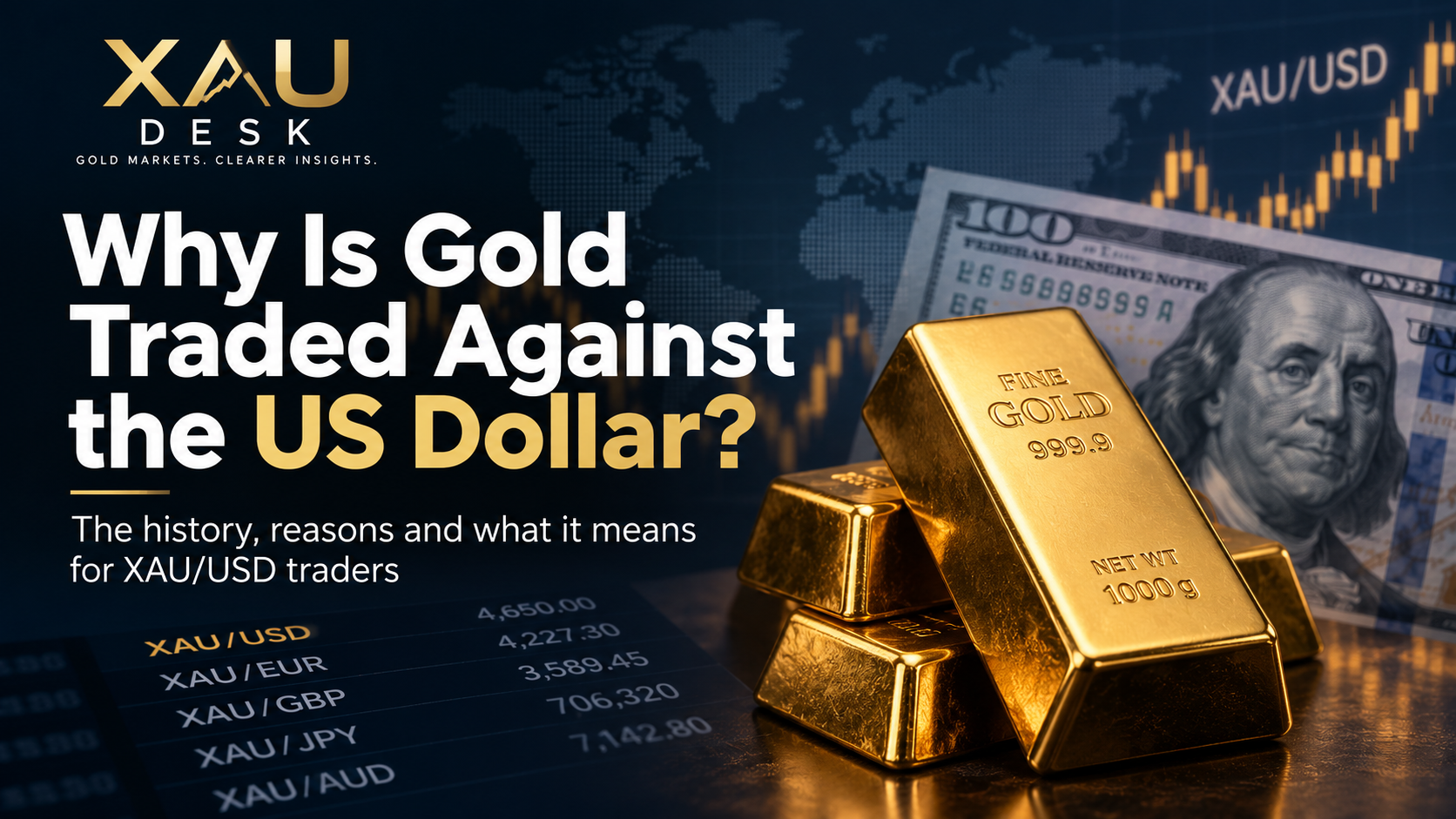
Gold is traded and quoted internationally in US dollars mainly because the dollar functions as the world’s leading reserve and trading currency, giving global gold markets a deep and widely recognised benchmark for pricing. International spot gold prices are commonly quoted as XAU/USD, even though gold is bought and sold in financial centres and local currencies around the world. Understanding this relationship is the first step to understanding how the gold market actually works.
Key Takeaways
• The US dollar is the principal international pricing currency for gold because of its reserve-currency status and its central role in global trade and finance.
• XAU/USD simply shows how many US dollars one troy ounce of gold is worth.
• Pricing gold in a single, widely held currency supports deep liquidity and efficient global price discovery.
• US dollar strength or weakness can influence gold prices, but the relationship is not fixed or automatic.
• Gold and the US dollar do not always move in opposite directions — other forces, such as real yields, inflation expectations, and safe-haven demand, also matter.
What Does XAU/USD Mean in Gold Trading?
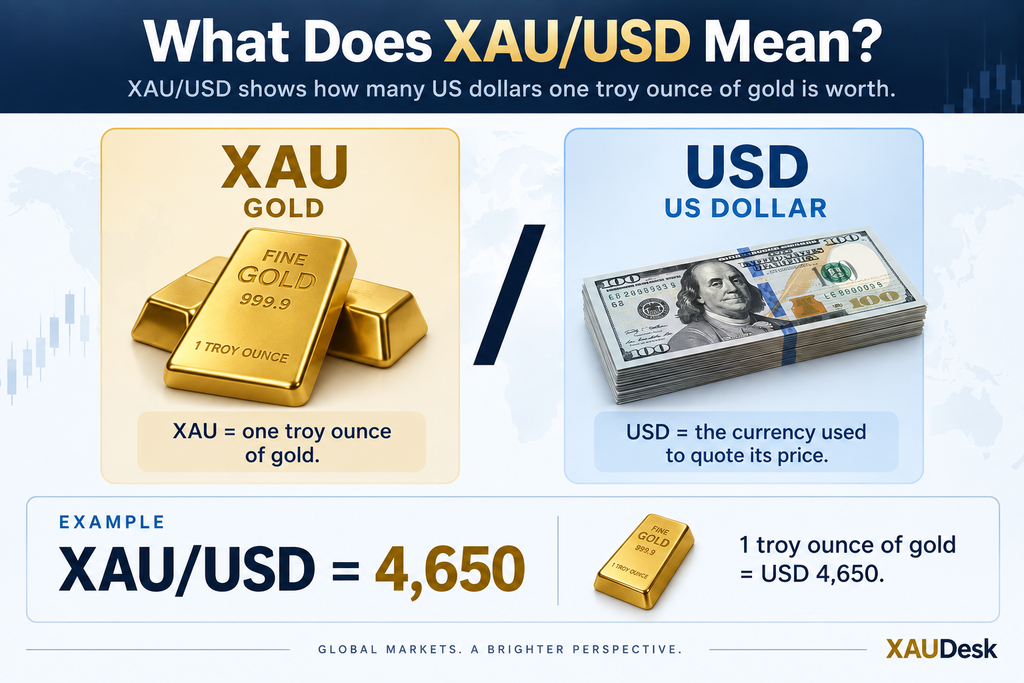
In financial markets, gold is identified by the code XAU. Under the ISO 4217 convention, the ‘X’ is used for units not associated with a specific country, while ‘AU’ reflects gold’s chemical symbol, derived from the Latin word aurum. When you see the pair XAU/USD, it means gold is being priced against the US dollar — the same logic used in currency pairs like EUR/USD or GBP/USD.
For example, if XAU/USD is quoted at:
XAU/USD = 4,650
This means one troy ounce of gold is priced at USD 4,650. XAU is the base “currency” being measured, and USD is the quote currency used to express its value. This convention makes it straightforward to compare gold’s value across time and across markets, because the price is always expressed in the same monetary unit. New to XAU/USD? Our Complete Guide to Gold Trading explains how the gold market works, what moves XAU/USD, trading sessions, strategies, risk management and broker selection.
Why Is Gold Priced in US Dollars?
Gold could, in theory, be priced in any currency. In practice, international markets converged on the US dollar for a combination of historical, structural, and practical reasons.
The US Dollar’s Role as the World’s Leading Reserve Currency
Central banks around the world hold a significant share of their foreign exchange reserves in US dollars. According to the International Monetary Fund’s Currency Composition of Official Foreign Exchange Reserves (COFER) data, the dollar has historically represented the largest single share of global reserves of any currency. This reserve status gives the dollar an outsized role in how international assets, including commodities like gold, are priced and traded.
Because so many governments, institutions, and banks already hold and transact in US dollars, using the dollar as gold’s pricing currency reduces friction for the widest possible range of market participants.
Global Liquidity and Efficient Price Discovery
Gold trading is concentrated in a small number of highly liquid global hubs, including London, New York, and increasingly Asian trading centres. The London Bullion Market Association (LBMA) oversees the London gold market, one of the largest global centres for over-the-counter gold trading, while CME Group operates COMEX, a major venue for gold futures.
Pricing gold in US dollars allows these different centres and time zones to reference a single, consistent benchmark. This depth of activity, concentrated around one currency, supports tighter pricing and more efficient price discovery than would be possible if gold were fragmented across many different national-currency quotes. To understand how this price discovery translates into the XAU/USD quote traders actually see, read our guide to how the gold price is calculated.
Standardisation Across Global Commodity Markets
The US dollar is not unique to gold. Oil, most industrial metals, and many other globally traded commodities are also conventionally priced in US dollars. This standardisation makes it easier for traders, institutions, and analysts to compare commodities, manage cross-market positions, and hedge exposure without constantly converting between currencies. Gold’s dollar pricing fits within this broader commodity-market convention rather than existing in isolation.
How Bretton Woods Helped Establish the Dollar’s Role
The dollar’s central role in gold pricing has roots in the Bretton Woods system, agreed in 1944. Under this framework, major currencies were pegged to the US dollar, and the dollar itself was convertible into gold at a fixed rate by foreign governments and central banks. This structure placed the dollar at the centre of the post-war international monetary system.
The direct convertibility of dollars into gold ended in 1971, when the United States suspended the gold standard. However, the infrastructure, conventions, and institutional relationships built around dollar-based pricing did not disappear. The dollar’s reserve-currency status, its role in international trade invoicing, and the depth of dollar-denominated financial markets meant it remained the natural benchmark currency for gold long after the formal link to gold convertibility was removed.
Interested in Trading Gold?
If you’re researching where to trade XAU/USD, you can explore the gold trading accounts available from Trade Nation and MultiBank Group.
How Does the US Dollar Affect Gold Prices?
Because gold is quoted in US dollars, movements in the dollar’s value can influence the XAU/USD price. When the dollar weakens against other major currencies, gold can become relatively cheaper for buyers using non-dollar currencies, which may support demand and put upward pressure on the price. When the dollar strengthens, the opposite dynamic can apply, potentially creating downward pressure on gold priced in dollars.
Other dollar-related factors that can influence gold include:
• Changes in US real interest rates and Federal Reserve monetary policy
• Shifts in US inflation expectations
• US economic data releases that affect expectations for future policy
• Broader risk sentiment, which can affect demand for both the dollar and gold as perceived safe assets
These are tendencies rather than fixed rules, and the strength of any relationship can vary considerably depending on prevailing market conditions.
Typical Gold–US Dollar Relationship
| US Dollar Movement | Potential Effect on Gold (XAU/USD) |
| US dollar strengthens | Can create potential downward pressure on gold, all else being equal |
| US dollar weakens | Can create potential upward support for gold, all else being equal |
| US dollar stable, other drivers active | Gold price can be driven more by yields, inflation expectations, or safe-haven demand |
Does Gold Always Move Opposite to the US Dollar?
Gold and the US dollar have historically shown a tendency to move in opposite directions at various points, but this is an observed tendency rather than a guaranteed relationship. Both assets can rise together, for example during periods of heightened geopolitical uncertainty or financial stress, when investors seek safety in both gold and dollar-denominated assets simultaneously.
Real yields, central bank policy expectations, inflation dynamics, and broader risk appetite can all pull gold and the dollar in the same direction at times, even while a dollar-gold link exists in the way the asset is priced. For a deeper look at when and why gold tends to fall as the dollar strengthens, and the conditions under which that relationship breaks down, see the dedicated article below.
Can Gold Be Traded in Currencies Other Than USD?
Yes. While USD is the standard international benchmark, gold can also be quoted against other major currencies, including XAU/EUR, XAU/GBP, XAU/JPY, and XAU/AUD. These cross-rates are typically derived from the XAU/USD price combined with the relevant USD exchange rate.
As a simplified worked example, to estimate XAU/EUR from XAU/USD and EUR/USD:
XAU/EUR ≈ XAU/USD ÷ EUR/USD
If XAU/USD is 4,650 and EUR/USD is 1.10, then XAU/EUR would be approximately 4,650 ÷ 1.10, or roughly 4,227. This reflects how many euros one troy ounce of gold is worth, based on prevailing exchange rates. The precise formula depends on how each currency pair is conventionally quoted, but the underlying principle is consistent: non-USD gold prices are generally derived from the dollar benchmark rather than set independently.
For traders and investors outside the United States, this means local-currency gold prices can move for two separate reasons: changes in the underlying USD gold price, and changes in their own currency’s exchange rate against the dollar.
Why Does the Gold-Dollar Relationship Matter to XAU/USD Traders?
For anyone trading XAU/USD, the dollar is not a background detail — it is one half of the instrument itself. Understanding how dollar strength or weakness can interact with gold helps traders interpret price moves in context, rather than assuming every gold price change is driven by gold-specific news.
This also means that US economic data, Federal Reserve communications, and broader dollar sentiment are worth monitoring alongside gold-specific drivers such as central bank buying, jewellery and industrial demand, and safe-haven flows. None of these factors operates in isolation, and experienced XAU/USD traders typically weigh several of them together rather than reacting to any single input. For the broader framework — including what moves gold, trading sessions, strategies, risk management and broker selection — read our Complete Guide to Gold Trading (XAU/USD).
Compare XAU/USD Trading Options
If you’re considering trading gold, you can explore XAU/USD trading through Trade Nation or MultiBank Group.
Conclusion
Gold is traded against the US dollar because international financial markets rely on a common, liquid benchmark currency, and the dollar’s reserve-currency status, trading infrastructure, and role in global commodity markets make it the natural choice. This convention, reinforced historically by the Bretton Woods system, has persisted even though the dollar’s direct convertibility into gold ended in 1971.
Movements in the US dollar can influence the XAU/USD price, sometimes putting pressure on gold and at other times providing support, but this relationship is not mechanical. Interest rates, inflation expectations, and broader market sentiment all play a role alongside the dollar. Now that you understand why gold is benchmarked against the US dollar, the next step is understanding how the XAU/USD price itself is formed. Read our guide to how the gold price is calculated for a deeper look at gold pricing, quotes and price discovery.
Looking for a Gold Broker?
Frequently Asked Questions
Why Is Gold Priced in US Dollars?
Gold is priced in US dollars mainly because of the dollar’s role as the world’s leading reserve currency and its central position in global trade and financial markets, which supports deep liquidity and a consistent international benchmark.
What Does XAU/USD Mean?
XAU/USD shows the price of one troy ounce of gold expressed in US dollars. XAU is the code for gold, and USD is the currency used to quote its value.
Does Gold Always Fall When the US Dollar Rises?
No. A stronger dollar can create downward pressure on gold, but the two do not always move inversely. Other factors, such as real yields, inflation expectations, and safe-haven demand, can offset or override the typical dollar relationship.
Can Gold and the US Dollar Rise at the Same Time?
Yes. During periods of financial stress or heightened uncertainty, both gold and the US dollar can attract safe-haven demand simultaneously, causing them to rise together.
Can Gold Be Traded in Currencies Other Than USD?
Yes. Gold can be quoted against other major currencies, such as XAU/EUR, XAU/GBP, XAU/JPY, and XAU/AUD. These cross-rates are generally derived from the USD gold price and the relevant currency’s exchange rate against the dollar.
What US Economic Data Can Affect Gold Prices?
US inflation data, employment reports, and Federal Reserve policy decisions and communications are among the data points commonly watched by gold market participants, since they can shape expectations for US interest rates and the US dollar.