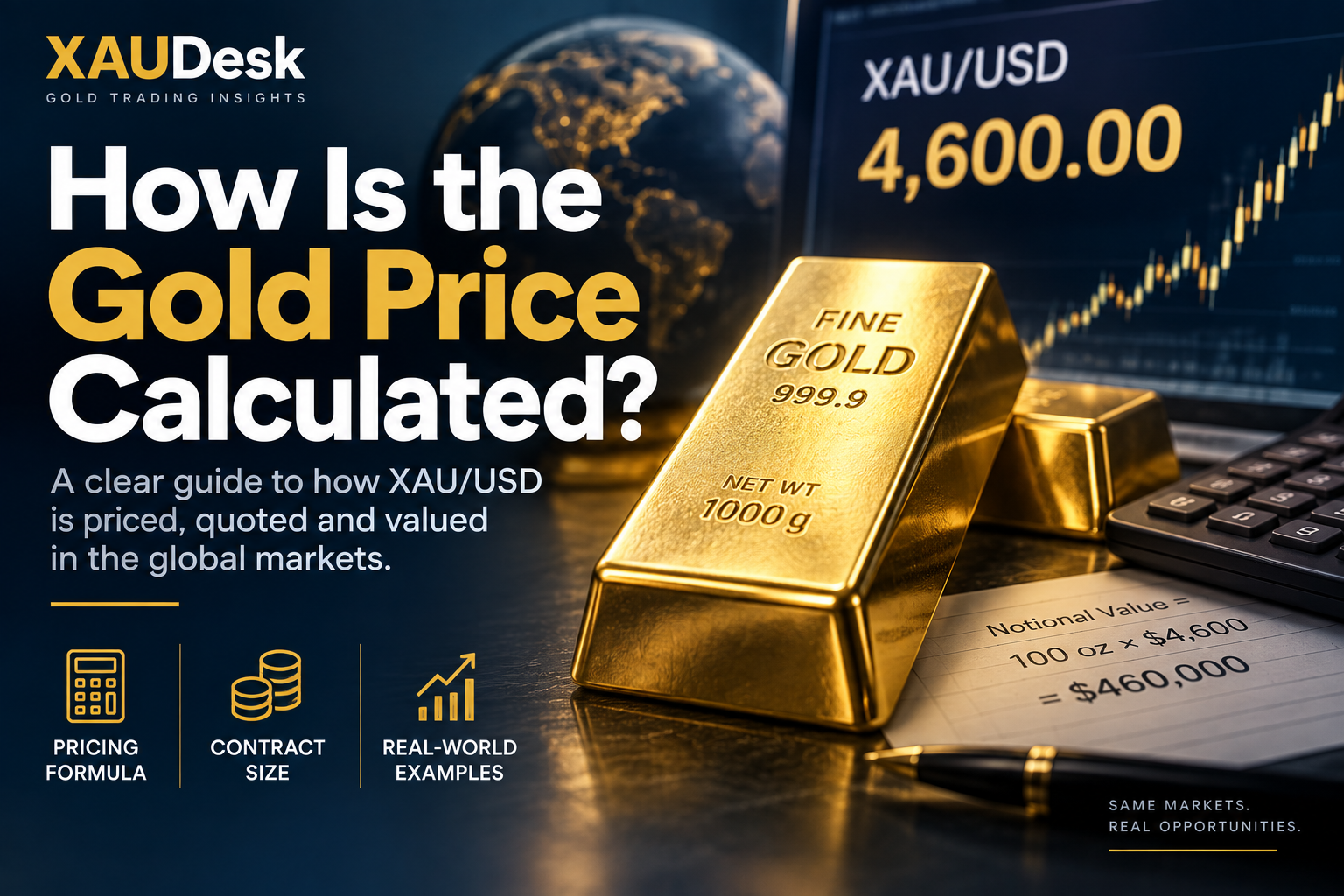
There is no formula for the gold price. No government, bank, or exchange plugs numbers into an equation and publishes an answer. The number you see on your trading screen is the result of continuous price discovery across interconnected OTC and futures markets, where institutions, dealers and investors continuously update the prices at which they’re willing to buy and sell gold.
There is no single official live gold price — there are closely aligned tradable prices across global markets.
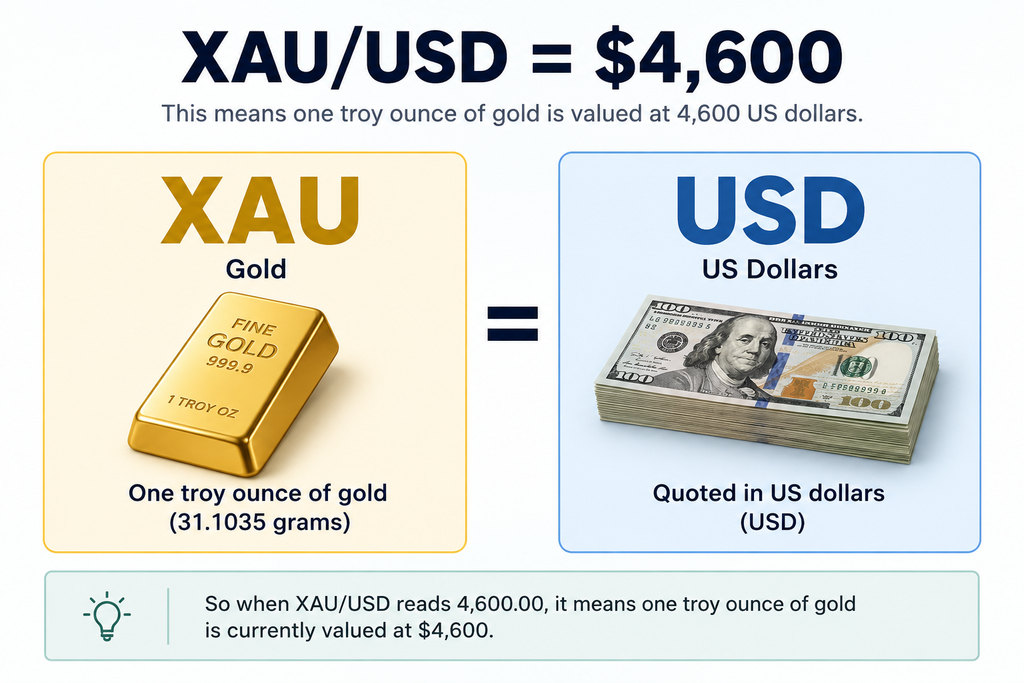
The quote you’re actually looking at, XAU/USD, measures the value of one troy ounce (31.1035 grams) of fine gold in US dollars. That figure moves constantly during market hours because it’s being remade in real time, not looked up.
This article walks through why there’s no single “gold price formula,” how the London OTC market and COMEX futures interact, where the official LBMA benchmark fits in, how liquidity providers turn institutional pricing into a tradable retail quote, and how to read and calculate a position from an XAU/USD quote yourself. If you’re new to the gold market, start with our Complete Guide to Gold Trading (XAU/USD) for a broader introduction to how gold trading works, what moves prices, trading sessions, risk management and broker selection.
Key Takeaways
● No single formula. Gold prices emerge from continuous buying and selling across interconnected markets — not a centralized calculation.
● The quoted asset. XAU/USD is the price of one troy ounce (31.1035g) of fine gold, quoted in US dollars.
● Two core pricing venues. London’s OTC market is central to wholesale spot and unallocated gold trading; COMEX futures in New York contribute heavily to electronic price discovery.
● Arbitrage keeps markets aligned. Institutional traders immediately trade away meaningful gaps between futures, spot, and regional hubs.
● Traders pay a spread, not a midpoint. Retail execution happens against a broker’s bid/ask quote, built from liquidity-provider feeds — not the mid-market average shown on financial news sites.
Is the Gold Price Actually “Calculated”?
It’s worth addressing the premise in the question directly, because it’s a common misconception. Unlike an index such as the CPI, or a derivative valuation like the Black-Scholes model, gold has no formula that takes a set of inputs and outputs “the price.” There’s no committee computing it from a basket of costs or a mathematical model.
What actually exists differs by venue. On exchange-traded markets such as COMEX, bids and offers interact in a centralized electronic order book, and trades execute where they cross. In London’s wholesale OTC gold market, there’s no single central order book — pricing instead emerges through bilateral and multi-dealer trading between banks and institutions, each continuously updating the levels at which they’re willing to buy or sell.
These interconnected venues — exchange-based and OTC — together contribute to continuous gold price discovery: a live, constantly-updating consensus of what gold is worth right now, based on who’s willing to trade at what level.
It’s important to separate this from a related but different question. This article explains how the number is formed — the mechanics of price discovery. It doesn’t cover why gold moves the way it does over time — the macro forces like inflation, real yields, and central bank demand. That’s a deliberately separate topic.
What Does the Quoted Gold Price Actually Represent?
Before looking at how the price is formed, it helps to be precise about what’s actually being quoted.
What Does the XAU/USD Ticker Mean?
XAU/USD follows the same currency-pair convention used across forex markets. XAU is the ISO 4217 code for gold — the “X” prefix is the designation used for non-national assets like precious metals, in place of a country code. By market convention, XAU/USD is expressed as US dollars per troy ounce, with USD as the quote currency.
So when XAU/USD reads 4,600.00, it means one troy ounce of gold is currently valued at $4,600. The mechanic is identical to a currency pair like EUR/USD — you’re always looking at the value of the first asset, expressed in units of the second.
Gold has been priced predominantly in US dollars for historical and structural reasons — largely tied to the dollar’s role as the world’s reserve currency and gold’s post-Bretton Woods trading history. For a deeper explanation, read our guide to why gold is traded against the US dollar.
Why Gold Is Quoted in Troy Ounces
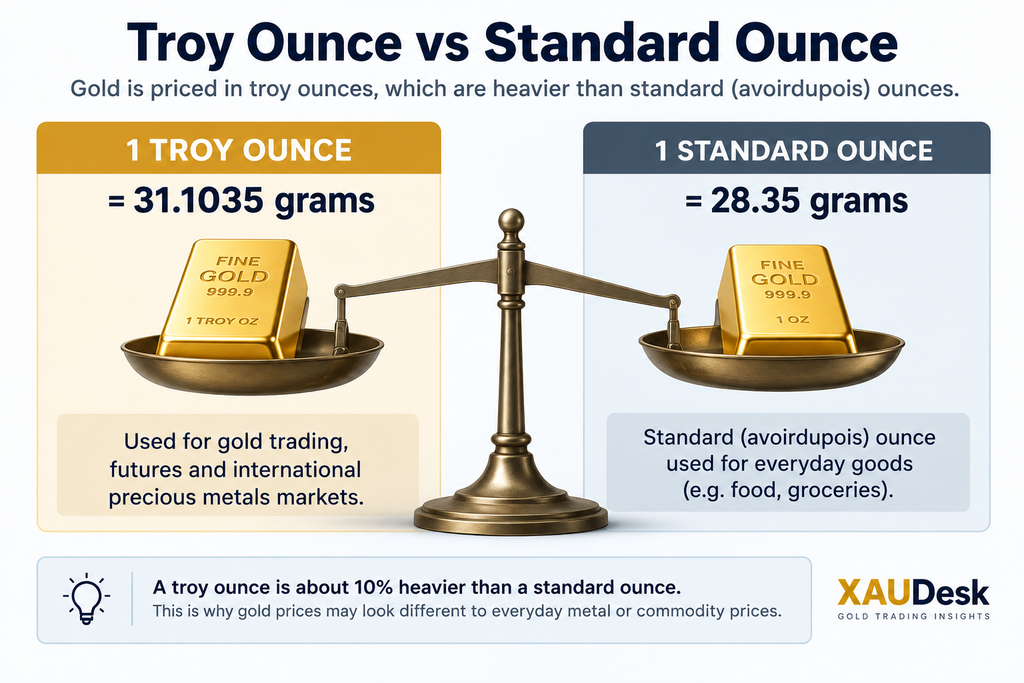
Gold isn’t weighed in the ounces used for everyday goods. A troy ounce equals exactly 31.1035 grams, while the standard avoirdupois ounce (used for groceries, for instance) is about 28.35 grams — roughly 10% lighter. The troy system is the historical standard for precious metals and remains the unit used across wholesale bullion trading and futures contracts today.
Wholesale spot-market gold is also traded to a purity standard. Institutional “Good Delivery” bars must meet a minimum fineness of 99.5% (995.0 parts per thousand), a specification maintained by the London bullion market’s clearing rules. This standard underpins the wholesale physical market — it doesn’t mean a retail XAU/USD CFD or rolling spot position represents ownership of, or a claim on, a specific Good Delivery bar.
How the Spot Gold Price Is Formed Across Global Markets
Gold’s price isn’t discovered on one exchange. It’s formed across several interconnected venues that operate on different mechanics but stay closely tied together.
The London OTC Wholesale Market
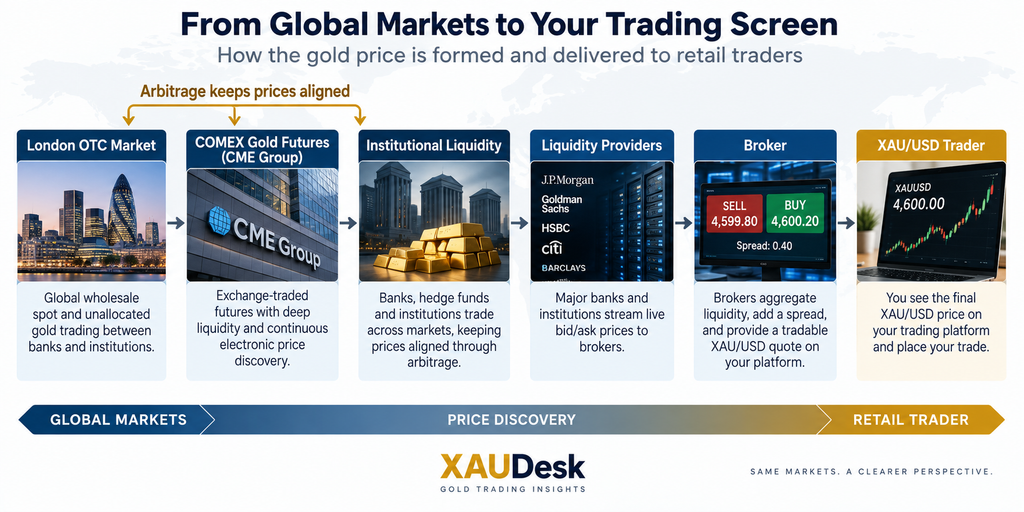
London has functioned as the historical center of the physical gold market for centuries, and it remains the primary venue for wholesale, unallocated bullion trading — often referred to as “Loco London” gold. This isn’t a centralized exchange with a single order book; it’s an over-the-counter (OTC) market where major bullion banks trade bilaterally with one another, settling and clearing physical gold obligations among themselves.
COMEX Gold Futures and Electronic Price Discovery
Alongside London’s physical market, COMEX — part of CME Group, based in New York — operates the world’s most actively traded gold futures contract (ticker: GC). Unlike the bilateral OTC structure in London, COMEX is a centralized, electronic exchange with continuous order-book trading, deep speculative participation, and standardized contract terms.
COMEX futures contribute heavily to electronic price discovery, while London OTC remains central to wholesale spot gold trading. Futures prices reflect the market’s forward-looking expectations for gold and are mathematically connected to the spot price through financing costs (the “cost of carry”) and delivery mechanics.
How Arbitrage Keeps Global Gold Markets Aligned
With gold trading simultaneously in London, New York, Zurich, Shanghai, and elsewhere, what keeps these venues from drifting apart? Arbitrage.
Institutional trading desks, market makers, and automated systems constantly monitor the relationship between COMEX futures, London spot, and regional pricing hubs. If futures prices rise meaningfully above what the cost of carry justifies relative to spot, arbitrageurs sell the relatively expensive futures contract and buy the relatively cheap spot gold, capturing the difference — and in doing so, pushing the two prices back toward alignment. This activity happens continuously and is largely what keeps gold’s price economically consistent across markets that are legally and operationally separate.
What Is the LBMA Gold Price Benchmark?
It’s worth distinguishing the live spot price — which changes continuously — from the LBMA Gold Price, a formal benchmark.
The LBMA Gold Price is a regulated electronic auction, administered by ICE Benchmark Administration (IBA), run twice each London trading day (10:30 a.m. and 3:00 p.m. London time). It isn’t used for retail CFD or spot trading — it exists primarily so that mining companies, refiners, central banks, and institutional funds have a single, transparent, auditable reference price for settling physical contracts and valuing gold holdings.
Retail XAU/USD quotes are generally based on continuous market pricing rather than the twice-daily benchmark itself — how that continuous pricing is built is covered next.
How Market Prices Become the XAU/USD Quote on Your Screen
Everything so far has covered institutional price discovery. Now, the shift to what actually appears on a trader’s platform.
Bid, Ask, and the Non-Executable Mid-Market Rate
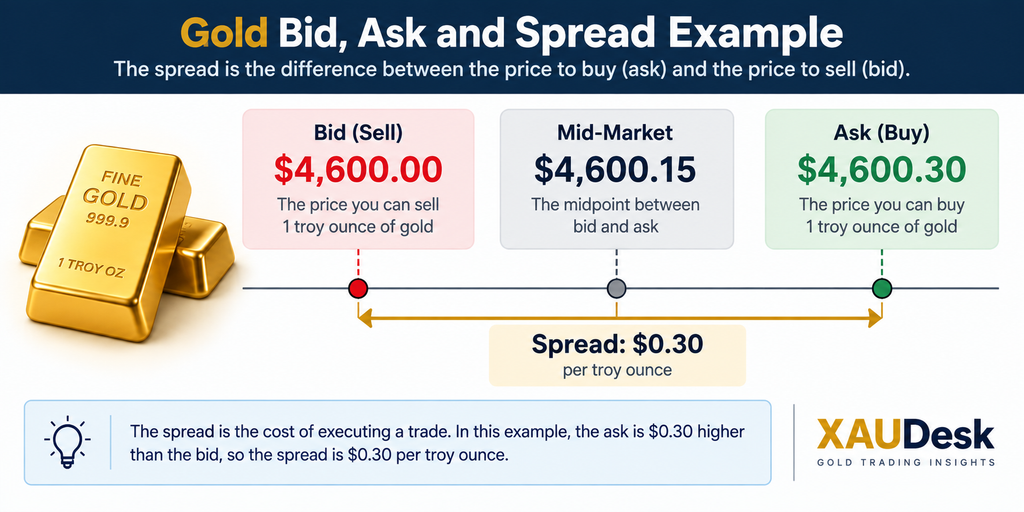
Every tradable XAU/USD quote has two sides:
● Bid — the price at which you can sell to your broker.
● Ask (or offer) — the price at which you can buy from your broker.
Financial news sites and charting platforms may display indicative, reference or mid-market pricing rather than the exact executable bid and ask available through your broker. These prices can be useful as a market reference, but they are not necessarily the prices at which a retail trader can execute an order. Actual retail trades occur against the executable bid or ask that your broker offers.
How Liquidity Providers Aggregate Gold Feeds
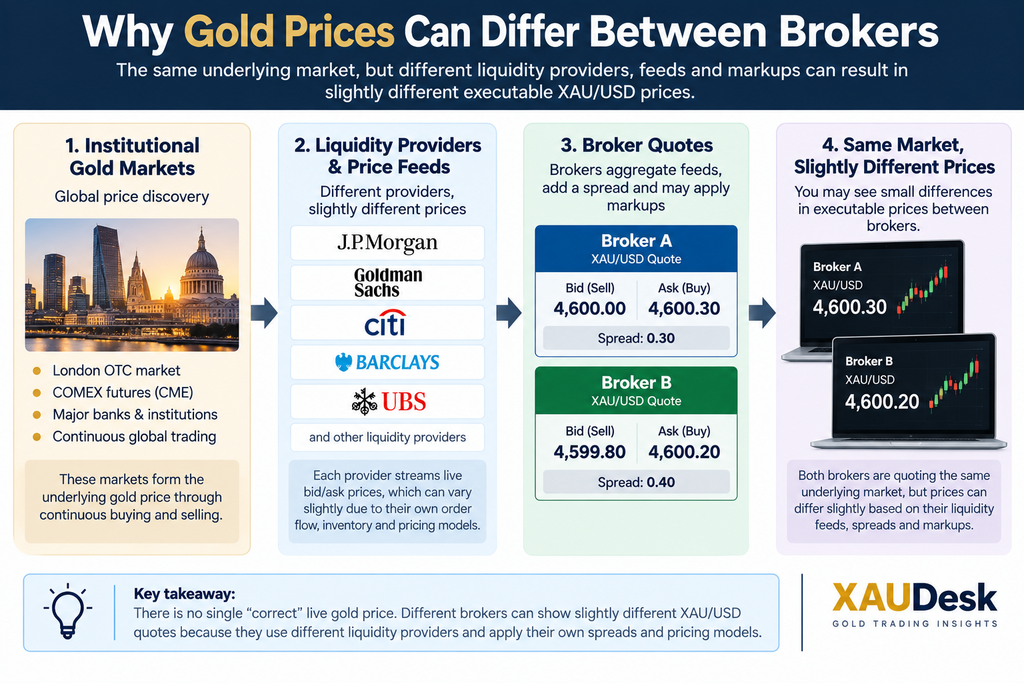
Retail brokers generally don’t trade gold directly on COMEX or in the London OTC bullion market themselves. Instead, many connect to one or more institutional or non-bank liquidity providers (LPs) — firms that stream continuous, executable bid/ask pricing sourced from the broader institutional market.
Where a broker uses multiple LPs, an aggregation engine typically compares the incoming feeds, selects the best available bid and best available ask across them, and streams that composite quote to the trading platform. Some brokers may also internalise part of their client flow rather than routing every trade externally. The exact arrangement depends on the broker’s execution and pricing model, and this is one of the reasons pricing can vary slightly from one broker to the next, covered further below.
Why Do Gold Prices Differ Between Brokers?
If gold trades on the same underlying global markets, why might two brokers show slightly different XAU/USD prices at the same moment?
Retail Spreads and Broker Markup Models
Brokers generally use one of two pricing structures:
● Raw-style pricing — typically tighter quoted spreads combined with a separate commission. The “raw” label doesn’t necessarily mean the trader receives a literal, unaltered institutional feed — the exact pricing chain still depends on the broker.
● Spread-only pricing — there’s no separate commission; the broker’s margin is built into the quoted bid/ask spread itself.
Many XAU/USD products use variable spreads that can widen or narrow with liquidity and volatility, typically tightening during high-liquidity sessions and widening around major news events or thin trading periods — though pricing structures vary by broker and account type, and some products may offer fixed spreads.
Liquidity Sources and Server Latency
Because spot gold is decentralized and OTC by nature, different brokers connect to different liquidity pools with different depths of book. Server location adds a further variable — a server in London (LD4) versus New York (NY4), for example, can introduce small latency differences, which matter most in the seconds around fast-moving economic releases.
Practical Example: How to Read and Calculate an XAU/USD Quote
Calculating Spread Cost and Position Notional Value
For illustration, assume XAU/USD is trading around $4,600 per troy ounce, quoted as:
- Bid: $4,600.00
- Ask: $4,600.30
Spread = Ask − Bid = $4,600.30 − $4,600.00 = $0.30 per troy ounce
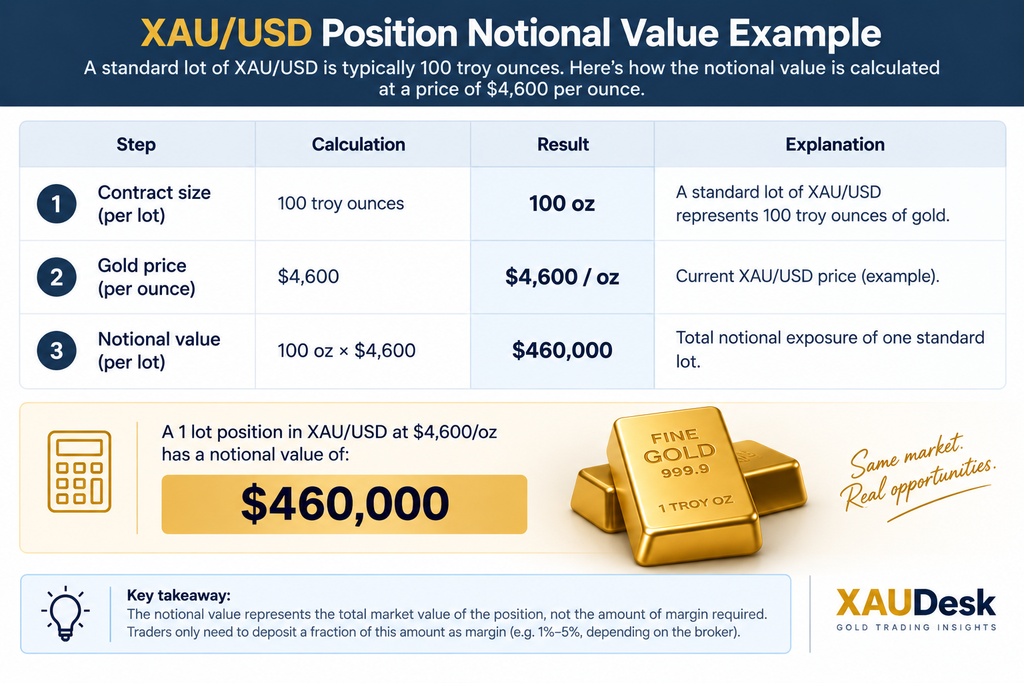
For this example, assume the broker defines 1.00 lot of XAU/USD as 100 troy ounces. This is a hypothetical figure for illustration only — contract specifications vary by broker and product, so always confirm the exact lot size on the platform you’re using before trading.
| Position Size | Ounces | Notional Exposure (at $4,600) |
| 1.00 standard lot | 100 oz | 100 × $4,600 = $460,000 |
| 0.10 mini lot | 10 oz | 10 × $4,600 = $46,000 |
| 0.01 micro lot | 1 oz | 1 × $4,600 = $4,600 |
Calculating the Dollar Impact of a Price Move
Using the same 100 oz assumption, if XAU/USD moves from $4,600.00 to $4,610.00 — a $10.00 per ounce increase:
● Micro lot (1 oz): 1 × $10.00 = $10.00 gain/loss
● Standard lot (100 oz): 100 × $10.00 = $1,000.00 gain/loss
For readers who want to go further — placing this pricing knowledge into a full trading process covering order types, position sizing, and risk management — the next step is XAUDesk’s complete guide.
Why Does the Gold Price Change Continuously?
Mechanically, prices move because incoming market orders continuously absorb the resting bid and ask liquidity sitting at the current price levels. Once that liquidity is consumed, the market has to reprice to the next available level to keep matching buyers with sellers. Automated and algorithmic trading systems can execute this repricing in fractions of a second as new data, rate expectations, or currency moves come through.
This article has focused entirely on how that repricing mechanism works — not on what triggers it economically. The macro side of that question — inflation, real interest rates, the US dollar, central bank demand, geopolitical risk — is covered in depth elsewhere.
What to Look for in a Broker When Trading XAU/USD
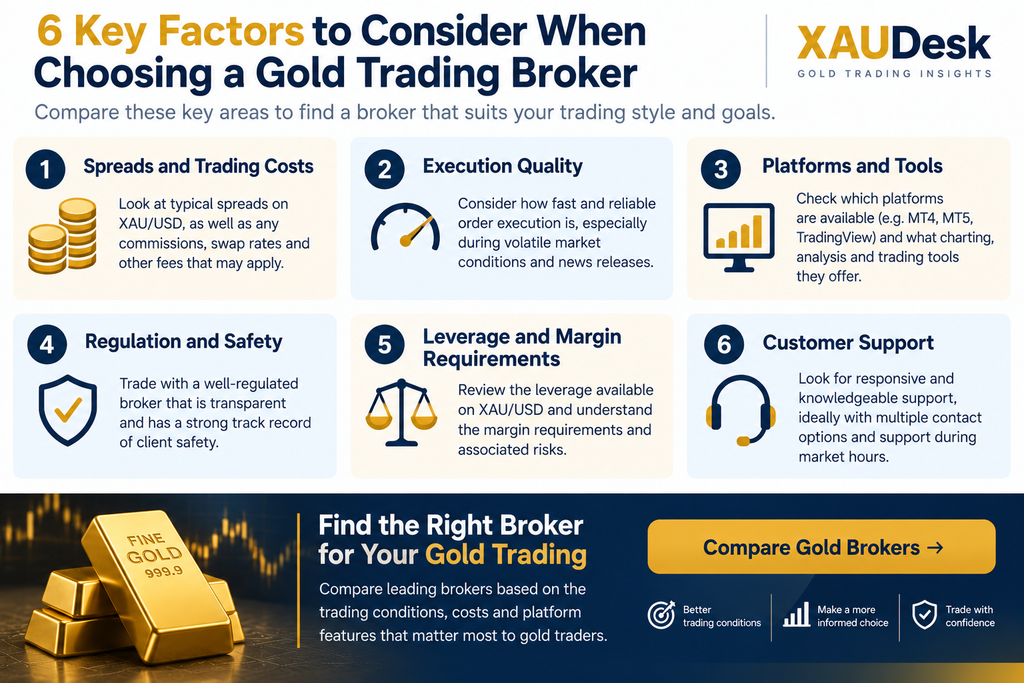
Understanding how the price is formed is one half of the picture. The other is understanding how your specific broker turns that price into something you actually trade on — because this affects your real trading cost.
A few factors worth evaluating:
● Spread model and pricing transparency — fixed vs. variable spreads, and whether pricing uses tighter raw-style spreads with a separate commission or a spread-only model.
● Contract sizing and leverage — minimum trade sizes, margin requirements, and how the broker defines a “lot” for gold specifically.
● Execution and slippage — how orders are routed and filled, particularly around volatile periods.
● Overnight financing (swaps) — the cost or credit applied for holding a leveraged gold position past the daily rollover.
● Regulatory oversight — which regulator(s) license the entity you’d actually be opening an account with.
● Legal entity and jurisdiction — the specific entity you’re contracting with can differ by region and affects investor protections.
XAUDesk reviews trading providers specifically from the perspective of XAU/USD traders — looking at how each broker’s pricing, execution, and account structure actually affects gold trading in practice.
Trade Nation offers XAU/USD trading with a variable spread — its fixed-spread pricing applies to indices, not gold. The broker holds regulatory licensing across multiple jurisdictions (including FCA, ASIC, and FSCA), offers no minimum deposit, and provides Islamic (swap-free) accounts alongside group-wide negative balance protection.
MultiBank Group
Frequently Asked Questions
Is There an Official Formula to Calculate the Gold Price?
No. The gold price isn’t computed from a formula — it’s the continuous output of decentralized order matching between buyers and sellers across global markets, in the same way most freely traded financial instruments are priced.
Is There a Single Global Gold Price?
Not exactly. Because spot gold trades OTC rather than on one centralized exchange, small fractional differences can exist between regional feeds at any given instant. Institutional arbitrage keeps these differences small and short-lived, but “the gold price” is really a tightly aligned set of prices across venues rather than one universal number.
Why Does My Broker’s Gold Price Differ From TradingView or Google?
Public financial portals and charting platforms may display indicative, reference, delayed or non-executable pricing depending on the data source and product. A broker, by contrast, provides the bid and ask available through its own pricing and liquidity arrangements — which is why the two displayed prices may differ slightly and rarely match to the cent.
How Does the LBMA Fix Differ From the Live Spot Price?
The spot price updates continuously throughout trading hours. The LBMA Gold Price, by contrast, is a formal benchmark set twice daily through a regulated electronic auction, used mainly for institutional settlement and valuation rather than live trading.
What Is the Minimum Trade Size for XAU/USD?
Minimum trade size varies by broker and product specification. Check the minimum order volume, contract size and lot-to-ounce relationship for the specific XAU/USD instrument you intend to trade. Margin requirements are separate from the position’s total notional value.
Why Does the Gold Price Update 24 Hours a Day During the Week?
Gold trading effectively follows global market hours around the clock on weekdays — moving from Sydney and Tokyo through to London and then New York — so price discovery continues almost uninterrupted from Sunday evening through Friday afternoon (US time), pausing only over the weekend.
Conclusion
Gold prices are formed across interconnected OTC and futures markets, kept closely aligned through arbitrage, and translated into executable XAU/USD bid/ask quotes by brokers and their liquidity providers.
London’s wholesale OTC market and COMEX futures both play central roles in that process — one anchoring physical spot trading, the other driving fast electronic price discovery — without either acting as the sole or definitive price setter. Liquidity providers then translate that institutional pricing into the executable bid/ask quote your broker streams to your platform as XAU/USD.