Generally, yes. Gold (XAU/USD) tends to exhibit greater realized and intraday percentage volatility than highly liquid major forex pairs such as EUR/USD, although the relationship depends on the currency pair, timeframe, volatility measurement and prevailing market regime.
On most percentage-based measures, gold’s day-to-day swings are wider than those of the deepest, most heavily traded currency pairs. That said, “more volatile than forex” is not a single, fixed statement. Some forex pairs — particularly those involving emerging-market or commodity-linked currencies — can match or exceed gold’s volatility for extended periods, and gold’s own volatility regime shifts considerably depending on macro conditions, from real interest rates to safe-haven demand.
This article works through what volatility actually measures, why XAU/USD behaves differently from a conventional currency pair even though it is quoted like one, how gold compares with EUR/USD, GBP/USD and USD/JPY, and what the difference means practically for stop-loss placement and position sizing.
Key Takeaways
- Gold (XAU/USD) generally shows higher realized and intraday percentage volatility than major forex pairs such as EUR/USD, though the gap narrows, and sometimes reverses, depending on the pair and the period examined.
- A larger nominal dollar move in gold does not automatically mean higher volatility — percentage-normalised movement is the measure that allows a fair comparison across assets with different price scales.
- Gold’s volatility is not constant. It varies by trading session, by proximity to major economic releases, and by the broader macro regime driving the market at the time.
- XAU/USD is quoted in a format similar to a currency pair, but the forces driving it — real yields, US dollar conditions, and safe-haven demand — are different from those driving a typical FX cross.
- Because gold’s typical range can be wider in percentage terms than many FX pairs, stop-loss distance and position size need to be set with that wider range in mind rather than carried over unchanged from forex trading.
What Does Volatility Mean in Financial Markets?
Volatility describes how much, and how quickly, an asset’s price moves over a given period. It is not a measure of direction — a market can be highly volatile while trending strongly or while going nowhere in net terms. In practice, volatility is usually expressed as a statistical measure of dispersion, most commonly a standard deviation of returns, and is often annualised so that assets can be compared on a like-for-like basis.
For a trader, volatility matters less as an abstract statistic and more as a practical input: it shapes how far price is likely to travel within a session, how wide a reasonable stop-loss needs to be, and how much a given position size is actually risking in dollar terms.
Realized Volatility vs. Implied Volatility
Realized volatility (sometimes called historical volatility) is backward-looking. It is calculated from an asset’s actual price movements over a defined period — for example, the standard deviation of daily returns over the past 20 or 30 trading days. It tells you how much the market has actually moved, not how much it might move next.
Implied volatility is forward-looking. It is derived from the pricing of options on the underlying asset and reflects what the options market is pricing in for future price movement. Implied volatility tends to rise ahead of known event risk — a central bank meeting, for example — and can spike sharply around unexpected news.
Both measures matter for comparing gold and forex, but most retail discussion of “which is more volatile” is really a discussion about realized volatility, since implied volatility data is less readily available to retail traders outside of options markets.
Gold Isn’t a Forex Pair — Even Though XAU/USD Looks Like One
XAU/USD is quoted the same way a currency pair is quoted — a base unit priced in US dollars — which leads many traders to treat gold as if it were simply another forex cross. It isn’t. Gold is a physical commodity with its own global supply, demand, and storage dynamics, and its USD quotation is a pricing convention rather than evidence that it behaves like a currency pair.
The reasons gold ended up quoted against the US dollar, and how that spot price is actually derived, are covered in more depth in our explainer on why gold is quoted against the US dollar and our guide to how spot gold pricing works. The short version relevant here is that gold’s price reflects a different set of inputs than a EUR/USD or GBP/USD rate — inputs that tend to produce a different volatility profile.
Because those inputs — real yields, safe-haven demand, central-bank reserve activity — don’t map neatly onto the interest-rate-differential framework that drives most G10 currency pairs, gold’s volatility can behave quite differently from forex volatility even when both are quoted in the same currency.
Why Is Gold So Volatile?
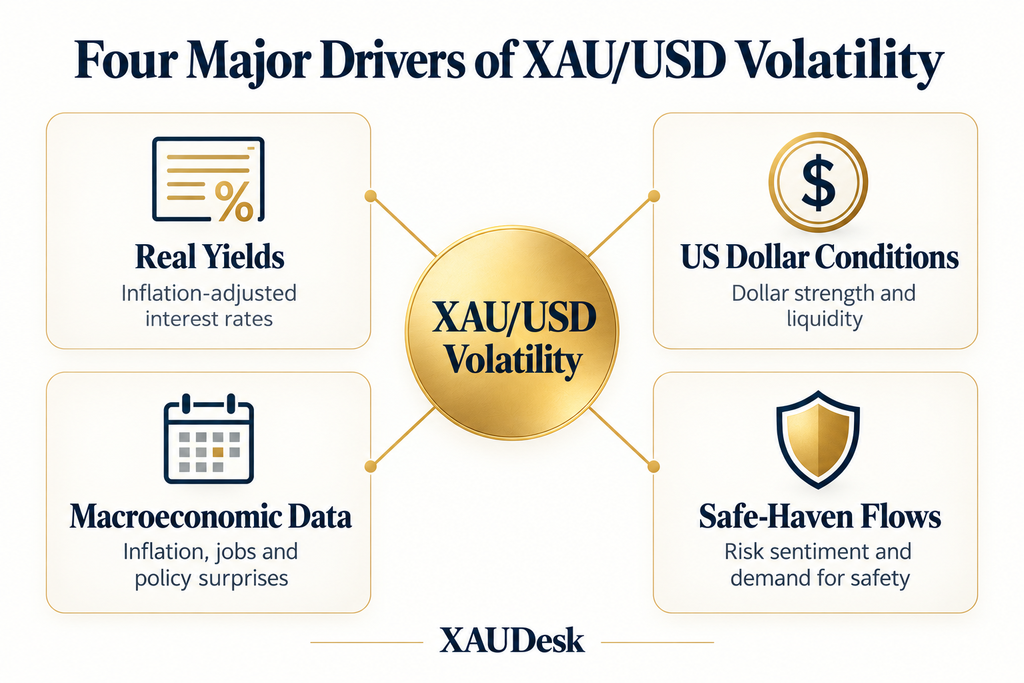
Several overlapping forces contribute to gold’s volatility profile. None of them operates in isolation, and their relative importance shifts depending on the macro backdrop.
Real Yields and Opportunity Cost
Gold pays no yield or dividend, so holding it carries an opportunity cost relative to interest-bearing assets. That opportunity cost is best captured by real (inflation-adjusted) yields on government bonds, particularly US Treasuries. When real yields fall, the cost of holding non-yielding gold falls with them, which can support demand; when real yields rise, that dynamic can work in reverse. Shifts in the real-yield outlook — driven by changing inflation expectations or interest-rate expectations — are a recurring source of gold volatility.
US Dollar Conditions
Gold is internationally benchmarked predominantly in US dollars, so changes in the dollar’s value can affect the price of gold for buyers using other currencies. Gold and the US dollar frequently move inversely, but the relationship is not fixed. Their correlation can weaken or reverse depending on the underlying macroeconomic or risk environment.
Macroeconomic Data and Central Bank Policy
Scheduled economic releases and central-bank decisions are among the most reliable sources of short-term gold volatility, because they move the real-yield and dollar inputs described above in a compressed window. Inflation prints, labour-market data, and interest-rate decisions from major central banks — particularly the US Federal Reserve — routinely produce sharp, fast moves in XAU/USD as the market repricers its expectations.
Safe-Haven and Risk-Sentiment Flows
Gold has a long-standing role as a perceived store of value during periods of geopolitical stress, financial-market instability, or sharp shifts in risk appetite. Demand linked to this role can arrive quickly and in size, which is one reason gold can experience volatility spikes that are disconnected from scheduled data releases. Safe-haven flows do not operate in exactly the same way in most major forex pairs. Currency pairs reflect the relative value of two currencies, meaning risk sentiment can affect both sides of the exchange rate, while gold can attract demand directly as a perceived store of value during periods of heightened uncertainty.
XAU/USD vs Major Forex Pairs: Comparing Volatility
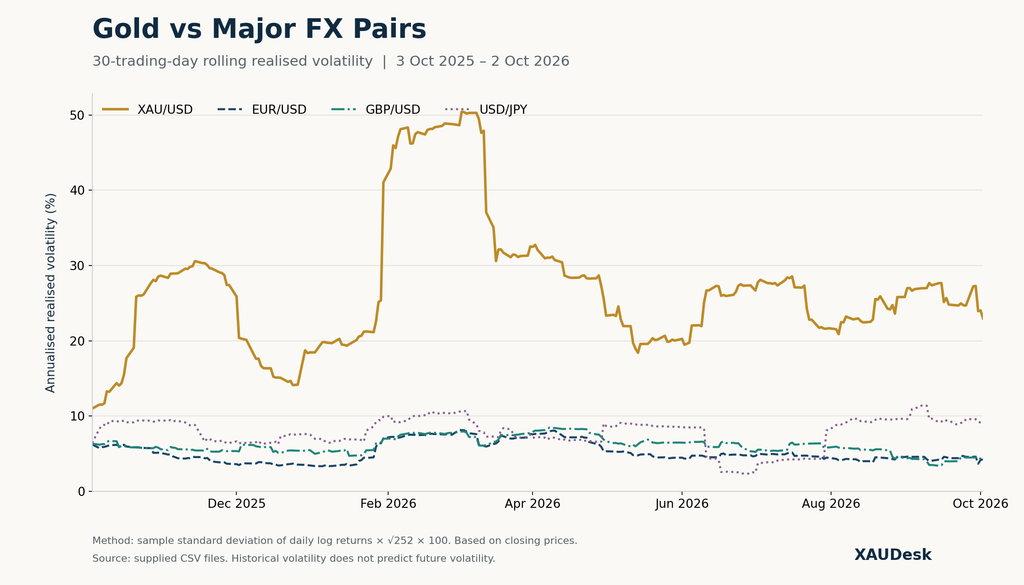
The table below outlines the broad, structural characteristics of gold and three major forex pairs. It is intended as a conceptual comparison of typical behaviour and drivers rather than a snapshot of current volatility levels, which change constantly and need to be measured with a consistent methodology and observation window.
| Market | Typical Volatility Profile | Primary Drivers | Sensitivity to US Data | Liquidity / Execution |
|---|---|---|---|---|
| XAU/USD | Generally higher percentage volatility than major FX pairs; prone to sharp event-driven spikes | Real yields, US dollar conditions, safe-haven demand, central-bank activity | High — reacts strongly to US inflation, employment and rate-decision data | Deep, but liquidity can thin around major releases, widening quoted spreads |
| EUR/USD | Lower typical volatility; the most heavily traded FX pair | Eurozone and US monetary policy differentials, relative growth expectations | High — reacts to both Eurozone and US data | Very deep and liquid across most trading hours |
| GBP/USD | Typically more volatile than EUR/USD; prone to sharp moves around UK-specific events | UK and US monetary policy, UK political and fiscal developments | High for US releases; also sensitive to UK-specific data | Deep, though liquidity can be thinner outside the London/US session overlap |
| USD/JPY | Variable; can be low in quiet periods and rise sharply during yield or intervention-related episodes | US–Japan yield differentials, Bank of Japan policy, risk sentiment | High — closely tied to US yield expectations | Deep, with occasional sharp liquidity shifts around policy surprises |
Nominal Movement vs Percentage Volatility: A Worked Example
One of the most common mistakes in comparing gold to forex is comparing nominal dollar or pip movement directly, without adjusting for the very different price scales involved. A $30 move in gold and a 30-pip move in EUR/USD are not comparable on their face, because they represent very different percentages of the underlying price.
Illustrative Example
Assume, for illustration only, that gold (XAU/USD) is trading at $2,600 per ounce and EUR/USD is trading at 1.0800. These are assumed prices for the purpose of this calculation, not current market prices.
A $30 move in gold from $2,600 to $2,630 represents a change of approximately 1.15%.
A 30-pip move in EUR/USD from 1.0800 to 1.0830 represents a change of approximately 0.28%.
In this illustrative example, the gold move is roughly four times larger in percentage terms than the EUR/USD move, even though both are sometimes described casually as “30 points.” This is the core reason nominal movement is not a reliable way to compare volatility across assets with different price scales — a $30 gold move and a 30-pip EUR/USD move simply are not equivalent units. Percentage-normalised movement, or a proper realized-volatility calculation, is needed for a meaningful comparison.
This single illustrative example does not prove that gold is always more volatile than EUR/USD — it demonstrates the calculation method. The actual comparison over time depends on the realized-volatility data referenced in the table above.
Understanding “Gold Pips” and Contract Specifications
Traders searching for gold volatility information often encounter the term “gold pips,” but this terminology is used inconsistently across brokers and platforms, and XAUDesk does not treat any single convention as universal.
XAU/USD is quoted in US dollars and cents per ounce, not in the fixed decimal-place pip structure used for most currency pairs. Some platforms define a “pip” on gold as a $0.10 move, others as a $0.01 move, and some avoid the term altogether in favour of points. Because this varies by broker and by product, XAUDesk prefers to describe gold movement in dollars, cents, and percentage terms wherever possible, to avoid ambiguity.
Contract specifications carry the same caveat. Many retail CFD specifications use 100 troy ounces as a standard XAU/USD contract size, but contract sizes, tick values and point conventions vary by provider and by product. Any risk calculation in this article that assumes a specific contract size is an illustrative assumption, not a universal standard.
When Is Gold Most Volatile? Trading Sessions and Event Risk
Gold’s volatility is not evenly spread across the trading day. Activity is generally lower during the Asian session and tends to build through the London session, with the London–New York overlap typically seeing the highest volume and the widest typical trading ranges, as liquidity from both major financial centres is active at once.
Scheduled US economic releases are a separate and often larger source of short-term volatility. Federal Reserve interest-rate decisions, US inflation data (CPI), and the monthly US employment report (Non-Farm Payrolls) are among the releases most reliably associated with sharp, fast XAU/USD moves, because they directly shift the real-yield and dollar expectations that drive gold. Liquidity providers may widen quotes around these releases as market depth changes, which can affect both volatility and execution quality.
Risk Management: Adapting to Gold’s Volatility Profile
Because gold’s typical percentage moves can be wider than those of major forex pairs, risk-management settings that work reasonably well on EUR/USD or GBP/USD may not transfer directly to gold without adjustment. This section covers the two areas most affected: stop-loss placement and position sizing.
Stop-Loss Placement
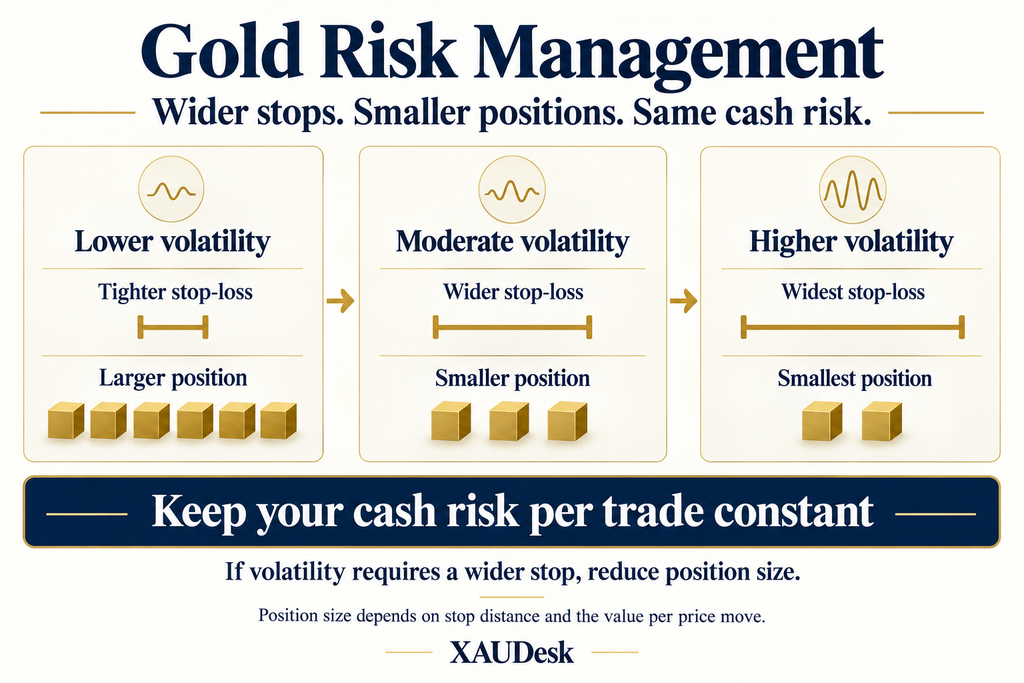
A stop-loss distance that is appropriate for a lower-volatility forex pair can be too tight for gold, where normal intraday noise may be wide enough to trigger it before the intended move plays out. Rather than applying a fixed dollar or pip distance across markets, stop-loss placement should generally be informed by the asset’s own recent trading range or volatility measure, alongside the specific trade setup and chart structure.
Position Sizing
Position size should be derived from the trade, not the other way around. In practical terms, that means starting from account equity and the maximum amount a trader is willing to risk in dollar terms on a given trade, then working out the position size that keeps the loss at the stop-loss level within that amount — rather than defaulting to a fixed lot size regardless of the stop-loss distance or the instrument’s typical volatility.
Illustrative Example Only — Not a Recommendation
A trader risking 1% of a $10,000 account ($100) with a stop-loss distance equivalent to $10 of gold movement per assumed 100-ounce contract would size the position so that a $10 adverse move corresponds to roughly $100 of risk. The 1% figure, the account size, and the 100-ounce contract assumption are illustrative only — not a recommendation — and should be recalculated for any actual account size, risk tolerance, contract specification, and stop-loss distance. Because gold’s typical range is often wider than a major FX pair’s, the same fixed lot size can represent meaningfully more dollar risk on gold than on forex, which is why position size needs to be recalculated for the instrument rather than carried over unchanged.
Compare Gold Brokers for XAU/USD Trading
XAUDesk reviews trading providers from the perspective of XAU/USD traders, assessing gold trading costs, spreads, execution conditions, platforms, financing and contract specifications.
Trade Nation
READ OUR TRADE NATION REVIEW →
MultiBank Group
READ OUR MULTIBANK GROUP REVIEW →
Frequently Asked Questions
Is Gold More Volatile Than Forex?
Generally, yes. Gold tends to exhibit greater realized and intraday percentage volatility than highly liquid major forex pairs such as EUR/USD, although the difference varies by pair, timeframe and market regime. Some forex pairs, particularly those involving emerging-market or commodity-linked currencies, can rival or exceed gold’s volatility for periods, so “forex” as a whole is not a single fixed benchmark.
Is Gold More Volatile Than EUR/USD?
Yes, on most realized-volatility measures. EUR/USD is one of the world’s most heavily traded currency pairs and typically shows lower percentage volatility than gold. The size of the gap varies by period and by market regime, and any specific comparison should be checked against current volatility data rather than assumed to be fixed.
Is XAU/USD More Volatile Than GBP/USD?
Gold is generally more volatile than GBP/USD as well, though the gap tends to be narrower than against EUR/USD, since GBP/USD itself can see sharp moves around UK-specific political and economic events. Both markets’ volatility levels shift over time, so any specific comparison should be based on current realized-volatility data rather than a fixed rule.
Why Is XAU/USD So Volatile?
XAU/USD’s volatility comes from several overlapping drivers: shifting real yields, changing US dollar conditions, Federal Reserve policy expectations, and US inflation and employment data all move gold’s key inputs in a compressed window. Sudden spikes are typically linked to surprise data, central-bank policy surprises, or a fast increase in safe-haven demand during geopolitical or financial-market stress, and liquidity providers may widen quotes around these events as market depth changes.
What Time Is Gold Most Volatile?
Gold most often sees its highest activity during the London–New York session overlap, when liquidity from both centres is active at once, and around major US economic releases. This is a general pattern rather than a fixed rule — local session times shift with daylight-saving changes, and event-driven volatility can occur outside these windows.
Is Gold Harder to Trade Than Forex?
Not objectively harder, but gold can be less forgiving of inappropriate position sizing and overly tight stop-losses, because of its typically wider percentage ranges and sensitivity to macroeconomic events. The required trading approach differs from most major FX pairs; that is a difference in what the market demands from a trader, not evidence that one market is universally easier or harder than the other.
Is Gold Riskier to Trade Than Forex?
Higher volatility can increase the speed and magnitude of P&L changes, but volatility and trading risk are not the same thing. Actual risk also depends on position size, leverage, stop-loss distance, contract specification, account size and execution conditions. Higher volatility does not automatically mean greater account risk if position size is adjusted appropriately for the instrument being traded.
Conclusion
Gold generally exhibits higher realized and intraday percentage volatility than major forex pairs such as EUR/USD, but the difference varies by currency pair, measurement method, timeframe and market regime. Nominal dollar movement is not enough on its own to measure volatility — percentage-normalised movement and realized-volatility measures provide a more meaningful comparison across assets with very different price scales.
Volatility itself is neither inherently positive nor negative; what matters is how it is measured and incorporated into trading and risk-management decisions. For gold specifically, that means recognising that its typical range can be wider than a major FX pair’s, and adjusting stop-loss placement and position sizing accordingly rather than carrying forex-based assumptions across unchanged.
For a full walkthrough of how to approach gold trading from strategy through execution, see our complete XAU/USD trading guide.